Skip to content
Education Sustainability Urban farming

What Is a Turnkey Urban Farm for Schools in Singapore?

James Yin
James Yin
~6 min read

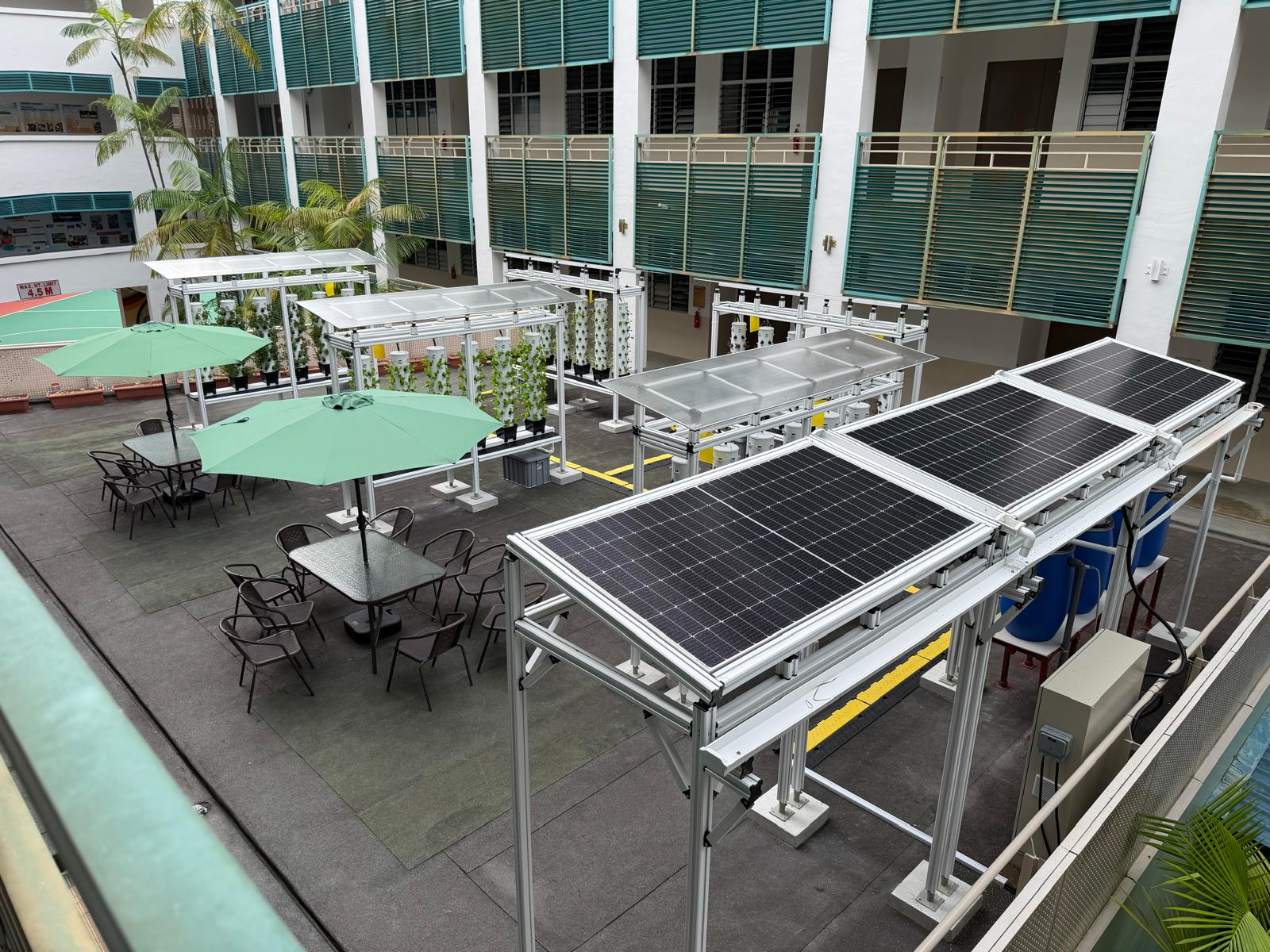
📷: Vertical Hydroponics Urban Farm with integrated solar-rain harvester & parasol rest area on mezzanine roof @ Hillgrove Secondary School

Schools in Singapore are aspiring to deliver stronger STEM outcomes, meaningful sustainability programs, and hands-on learning that connects students to real-world systems. At the same time, many campuses face limited space, tight operational capacity, and practical questions about how to run an on-site farm successfully.

That is why more institutions are exploring urban farm solutions for schools. A turnkey urban farm brings together design, installation, technology, training, and ongoing farm management in one structured solution, making it easier for pre-schools, primary, secondary  and tertiary institutions to launch productive, educational, and measurable farming programs.

For institutions considering campus urban farming in Singapore, the turnkey model reduces implementation risk and helps turn underused spaces into living learning environments.

What is a turnkey urban farm for schools?

A turnkey urban farm for schools is a complete, ready-to-operate farming solution designed for educational environments. Rather than asking educators or facilities teams to piece together infrastructure, crop planning, maintenance, and learning activities on their own, a turnkey model delivers an integrated setup that is planned, installed, and supported for long-term use.

In practice, that often includes:

  • Site assessment and feasibility planning

  • Urban farm design services tailored to the campus

  • Modular system selection and configuration

  • Installation and commissioning

  • Standard operating procedures and onboarding

  • Crop planning and operational guidance

  • Smart monitoring support

  • Ongoing maintenance and farm management services

  • Education and engagement programming to support student learning

This matters because schools are not commercial farm operators. Even when there is strong support from principals, facilities leaders, science departments, or sustainability teams, many institutions do not have the in-house time or technical expertise to operate a farm consistently.

The three essentials of a turnkey urban farm

A successful school farm is not just about putting equipment on site. The strongest turnkey urban farms combine three connected elements: design, installation, and ongoing farm management.

1. Design: creating the right farm for the school’s goals The design phase determines whether the farm becomes a lasting educational asset or an underused installation.

A strong design process should answer questions such as:

  • How much usable space does the campus have?

  • Is the main goal STEM instruction, sustainability education, food production, or all three?

  • Who will use the farm: students, educators, facilities teams, or community groups?

  • How much day-to-day involvement can the school realistically manage?

  • Is hydroponics, aquaponics, or another modular model the best fit?

For schools, good design balances educational value with operational simplicity.

V-Plus Agritech’s approach is built around modular, scalable, science-backed systems designed for sustainable urban farming. Its solutions support guided learning, hands-on engagement, and data-driven growing environments that can fit naturally into educational settings.

2. Installation: moving from concept to a working farm Installation is often where complexity becomes visible. Without the right support, schools may face avoidable delays, setup errors, or systems that are difficult to operate after launch.

A turnkey model simplifies this transition by managing the move from concept to live operation. Depending on the school’s needs, installation may include:

  • Prefabricated modular components

  • Plumbing and wiring setup

  • Environmental controls and sensors

  • Vertical growing structures

  • Water recirculation systems

  • Safety and site-readiness checks

  • System testing and commissioning

For educational institutions, one of the biggest advantages is reduced setup burden. Modular infrastructure can shorten build time, improve consistency, and make future expansion easier.

This is where V-Plus Agritech is especially relevant. Its modular “Stack & Grow” philosophy, vertical hydroponics and aquaponics capabilities, and prepared system elements align well with schools that need predictable deployment and user-friendly operations.

3. Ongoing farm management: what sustains the program long term This is often the most underestimated part of school farming.

Installing a farm is only the beginning. Keeping it healthy, productive, and educationally useful requires planning, monitoring, troubleshooting, and regular care. Staff transitions, term schedules, and operational demands can all affect continuity.

That is why ongoing management is a core part of effective urban farm solutions for schools.

A strong farm management service may include:

  • Regular maintenance and operational support

  • Crop scheduling and cultivation guidance

  • Performance monitoring

  • Troubleshooting and system optimisation

  • Training for school staff

  • Student engagement sessions or farm-based activities

  • Data tracking for educational and sustainability reporting

By combining hardware support, standard operating guidance, and operational assistance, V-Plus Agritech helps schools move beyond installation and build a program that continues to deliver value over time.


Why schools in Singapore are investing in campus urban farming

Schools and tertiary institutions are looking at campus urban farming because it supports multiple institutional goals at once.

It makes STEM learning tangible A well-designed school farm helps students move from theory to observation, experimentation, and analysis. Topics such as biology, environmental science, chemistry, engineering, mathematics, and systems thinking become easier to teach when students can monitor growth conditions, observe nutrient cycles, and work with real operational data.

This is why STEM education farming continues to gain interest. It creates a living platform for inquiry-based and interdisciplinary learning.

It strengthens school sustainability programs

Many schools want sustainability initiatives that go beyond awareness campaigns. A working farm gives institutions a visible way to connect food production, water-conscious growing, food literacy, and local resilience to daily campus life.

A school farm can support:

  • Campus ESG and sustainability reporting

  • Student engagement in food systems and waste awareness

  • Local food resilience education

  • Resource-efficient growing practices

  • Community engagement and green campus identity

When implemented well, farms can become a practical foundation for school sustainability programs rather than a one-off project.

It makes better use of limited campus space

Dense campuses in Singapore rarely have the luxury of large open plots. This is where vertical, modular, and smart urban farming systems become especially valuable. Rooftops, courtyards, sheltered walkways, and other underused campus areas can be adapted into productive growing environments without requiring a large land footprint.

How turnkey urban farms support hands-on STEM learning

A well-managed campus farm can function as a living lab across disciplines.

  • Science Students can study plant growth, water quality, ecosystems, biodiversity, and nutrient cycles through direct observation and experimentation.

  • Technology With connected sensors and monitoring tools, students can engage with IoT concepts, data logging, dashboards, and real-time system observation.

  • Engineering Students can explore water flow, modular structures, controlled environments, and design problem-solving in a practical setting.

  • Mathematics Crop planning, measurement, growth tracking, yield comparisons, and resource-use calculations create clear quantitative learning opportunities.

  • Sustainability and systems thinking Students can connect food production, water use, local resilience, and community impact in a way that makes sustainability concrete rather than abstract.

This is what makes STEM education farming so valuable. It helps schools create an environment where learning is active, measurable, and closely connected to real-world challenges.

How turnkey urban farms support measurable sustainability outcomes

Institution leaders often need more than a compelling idea. They need evidence of impact. A turnkey farm can contribute to measurable sustainability outcomes through:

  • Resource efficiency Water-efficient farming systems can support more responsible resource use in school environments.

  • Local food production Growing food on campus shortens the distance from harvest to consumption and strengthens food literacy.

  • Carbon-conscious campus initiative On-site production can support broader sustainability strategies focused on resilience, visibility, and reduced transport dependence.

  • Student participation and behaviour chang Farms can support student-led projects, produce donation initiatives, and wider awareness of food, nutrition, and sustainability.

  • Institutional storytelling and reporting A visible, interactive farm can strengthen how schools communicate their sustainability commitments to students, families, and external stakeholders.

For many institutions, this is where school sustainability programs become more practical, visible, and credible.

Why smart urban farming matters for schools

Schools need solutions that are manageable as well as innovative. That is why smart urban farming is especially relevant in education.

Smart systems can help schools:

  • Detect issues earlier

  • Make better growing decisions with data

  • Reduce operational friction

  • Give students access to applied technology learning

  • Scale from pilot projects to broader campus programs

V-Plus Agritech reflects this approach through modular infrastructure, data-driven cultivation support, and circular farming models designed for dense urban environments.

What to Look for in an urban farm partner

If your institution is evaluating urban farm solutions for schools, it helps to assess potential partners on a few practical criteria:

  • Educational alignment Can the solution support STEM, sustainability, and experiential learning goals in meaningful ways?

  • Operational support Will your team receive clear onboarding, SOPs, and ongoing assistance after installation?

  • Design flexibility Can the farm be adapted to your site conditions, available space, and programme goals?

  • Scalability Can the school start with a pilot and expand later without redesigning everything?

  • Smart monitoring and data support Does the solution help both staff and students learn from real operational data?

  • Long-term viability Is the provider equipped to support the farm as an ongoing programme rather than a one-time installation?

These questions matter because school farming success depends as much on continuity and usability as it does on technology.


A practical path to turnkey urban farming on campus

For many institutions, the biggest barrier is not interest. It is uncertainty around design, staffing, maintenance, and long-term outcomes.

A turnkey model addresses those concerns by combining design, installation, and farm management into one coordinated solution. That makes it easier for schools, polytechnics, universities, and training institutions to move from ambition to implementation with confidence.

At V-Plus Agritech, this reflects a broader mission to build, grow, engage, and educate through sustainable urban farming. By combining modular hydroponics and aquaponics solutions with farm management support and hands-on learning opportunities, the company helps schools create spaces that are productive, educational, and aligned with long-term sustainability goals.

Final thoughts

A turnkey urban farm for schools is more than a campus feature. It is a structured way to connect infrastructure, learning, and sustainability into one living system.

When design, installation, and ongoing farm management work together, schools are better positioned to deliver hands-on STEM learning, strengthen sustainability outcomes, and create deeper student engagement with the future of food.

For institutions exploring turnkey urban farms, the most effective solutions are the ones that make implementation manageable, learning meaningful, and long-term success realistic.

Share this post